
Introduction: When Everything Looks Right
You come across a matrimonial profile and, at first glance, everything seems perfect.
Good education.
A promising career.
A respectable family.
The right age.
The right location.
A strong family background.
Perhaps even the defence connection you were hoping for.
The families speak. The photographs are exchanged. Everyone seems impressed.
“This looks like a very good match.”
But there is an important question that often gets lost somewhere between the biodata, family introductions and background checks:
Is this actually the right person for you?
A matrimonial profile can tell you a great deal about someone’s qualifications and background. It cannot tell you how they handle disappointment, disagreement, responsibility, loneliness or change.
And that is where the difference between a good profile and a good life partner begins.

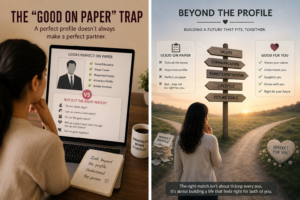
What Does “Good on Paper” Really Mean?
In matrimonial conversations, “good on paper” usually means that a person satisfies a collection of desirable criteria.
They may have:
- A good educational qualification
- A stable career
- A respectable family
- A compatible age
- Similar cultural background
- Financial stability
- A pleasing personality
- A defence connection
- Good social standing
- Similar lifestyle expectations
None of these things are unimportant.
In fact, they can be valuable indicators when searching for a life partner.
The problem begins when we assume that matching criteria automatically means matching lives.
Two people can tick every box on paper and still want completely different marriages.
One may want to live independently in a metropolitan city. The other may want to remain close to family.
One may prioritise career growth. The other may prioritise a slower, family-oriented lifestyle.
One may believe marriage means doing everything together. The other may strongly value independence.
Neither person is necessarily wrong.
They may simply be wrong for each other.
Your Biodata Is Not Your Personality
A matrimonial biodata is useful. But it is only an introduction.
Think of it as the cover of a book.
It tells you enough to decide whether you want to turn the page.
It doesn’t tell you what happens in Chapter 10.
A profile might say:
“Successful professional, family-oriented, adventurous and easy-going.”
But what does family-oriented mean?
Does it mean regular family visits?
Living with parents?
Financial responsibility toward parents?
Celebrating every festival together?
Or simply maintaining a close relationship with family?
Similarly, “career-oriented” can mean very different things to different people.
For one person, it may mean building a business.
For another, it may mean continuing a demanding corporate career.
For someone else, it may mean having the freedom to work even after marriage.
The words are the same. The expectations can be completely different.
The Five Things a Matrimonial Profile Cannot Tell You
1. How They Handle Conflict
You don’t really know someone by observing how they behave when everything is going well.
You learn much more by watching what happens when they disagree with you.
Do they listen?
Do they become defensive?
Can they apologise?
Do they need to win every argument?
Can they disagree without becoming disrespectful?
A successful marriage doesn’t require two people who never argue.
It requires two people who know how to disagree without damaging the relationship.
2. Their Relationship With Responsibility
Responsibility becomes much more important after marriage.
Bills need to be paid. Parents may need support. Careers change. Health issues arise. Plans don’t always work.
Ask yourself:
Does this person take responsibility when something goes wrong, or do they immediately look for someone to blame?
That tells you far more about future compatibility than a job title ever could.

3. Their Definition of a Good Marriage
This is one of the most overlooked questions in arranged marriage.
What does your prospective partner actually think marriage should look like?
Does a good marriage mean:
- Spending most of your free time together?
- Having separate hobbies?
- Living near parents?
- Travelling frequently?
- Building a business together?
- Having children soon?
- Maintaining two careers?
- Keeping finances completely separate?
- Sharing every major decision?
There is no universal answer.
The important thing is whether your definitions can coexist.
4. Their Relationship With Change
People don’t stay exactly the same.
Careers change.
Cities change.
Parents grow older.
Children arrive.
Financial circumstances fluctuate.
Military and defence careers can bring transfers, postings and periods of separation.
The person you marry at 28 may be navigating a completely different life at 38.
So instead of only asking:
“Do I like this person today?”
ask:
“Can we adapt together when life doesn’t go according to plan?”
5. How They Treat People Who Cannot Benefit Them
Watch how they treat:
- Service staff
- Drivers
- Colleagues
- Relatives
- Junior employees
- Strangers
- People with whom they disagree
Character often appears most clearly when there is nothing to gain from being impressive.
Compatibility Is Bigger Than Similarity
People often look for someone who is “similar.”
Similar education.
Similar family.
Similar interests.
Similar upbringing.
A shared defence background can certainly create familiarity and understanding. Defence families may share experiences that outsiders don’t immediately understand. But even within the defence community, every family and individual is different.
Shared background can create context.
It does not automatically create compatibility.
The more important question is:
Do your values work together?
You can love different foods and still build a wonderful marriage.
You can support different sports teams.
You can have different hobbies.
But differences in fundamental values can become much harder to navigate.
For example:
- Views on children
- Career expectations
- Financial responsibility
- Family involvement
- Independence
- Lifestyle
- Religion and traditions
- Location
- Personal boundaries
These are not small details.
They shape everyday married life.
The Defence Matrimony Advantage: Shared Understanding, Not Automatic Compatibility
For defence wards, there can be an additional layer to compatibility.
Growing up around transfers, cantonments, military schools, postings, service traditions and a close-knit defence community can create a shared cultural understanding.
That can be valuable.
Someone who has lived a similar lifestyle may understand things that would otherwise require lengthy explanations.
But even within defence matrimony, don’t assume:
“They are from the defence background, therefore they will understand everything about me.”
Instead, use the shared background as a starting point for deeper conversations.
Ask:
What did you like about growing up in a defence family?
What did you find difficult?
Would you want your future family to live similarly?
These answers can reveal far more than simply knowing someone’s father’s rank or service branch.
The “Would I Enjoy Everyday Life With This Person?” Test
Here’s a simple test that is often more revealing than a long list of matrimonial requirements.
Imagine that there is no wedding.
No photographs.
No relatives.
No social media announcement.
No honeymoon.
No elaborate ceremony.
Just an ordinary Tuesday.
You have both had a difficult day.
Dinner needs to be figured out.
One person is tired.
The other is irritated.
A family member has called with a problem.
Work starts early the next morning.
Would you still want this person beside you?
Marriage is made up mostly of ordinary Tuesdays.
The wedding is one day.
The honeymoon might be one week.
The marriage is thousands of ordinary moments.
Stop Looking for the Perfect Profile
A perfect matrimonial profile doesn’t exist.
And even if it did, a perfect profile wouldn’t guarantee a perfect marriage.
Instead of asking:
“Does this person meet all my requirements?”
try asking:
- Do I feel comfortable being myself around them?
- Can we talk about difficult subjects?
- Do I respect the way they think?
- Do they respect my ambitions?
- Can we disagree respectfully?
- Do our expectations about marriage align?
- Do we want broadly similar things from life?
- Can we grow together?
- Do I trust their character?
- Can I imagine ordinary life with them—not just the wedding?
These are harder questions.
But they are better questions.
Final Thought
Choosing a life partner is not the same as selecting the most profile.
The best match may not be the person who looks perfect on paper.
It may be the person with whom your values align, your differences feel manageable, your ambitions are respected and your ordinary life feels peaceful.
Don’t just look for someone who checks your boxes. Look for someone with whom you can build a life.
That is where a matrimonial search becomes more than a search for a profile.
It becomes a search for a partner.