
Finding the right life partner is about more than matching profiles. For Defence Wards, it is also about finding someone who understands the values, responsibilities, lifestyle, and unique experiences that come with being part of a defence family.
Whether you are exploring defence matrimony, considering a defence marriage, or have recently connected with someone through a defence ward matrimony platform, meaningful conversations can help you understand whether you are truly compatible.
Before saying “yes” to a prospective partner, take the time to discuss the questions that can shape your life after marriage.
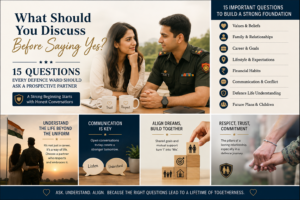
Here are 15 important questions every Defence Ward should ask a prospective partner before taking the relationship forward.
1. Where Do You See Yourself Living After Marriage?
One of the first things to discuss in a defence marriage is where you both see yourselves living.
A career connected to the defence forces can involve transfers, postings and changes in location. For some couples, this can mean moving between cities or living in different places during different stag
es of their careers.
Talk openly about:
- Preferred cities and locations
- Willingness to relocate
- Living in a military station or cantonment
- Possibility of living separately during certain postings
- Long-term plans for settling down
There may not be one perfect answer. What matters is that both partners understand each other’s expectations.
2. Are You Comfortable With the Defence Lifestyle?
A defence family can experience a lifestyle that is different from that of many civilian families.
Frequent transfers, demanding schedules, social responsibilities, official commitments and periods of separation can sometimes be part of the journey.
Ask your prospective partner:
“How comfortable are you with the lifestyle that may come with a defence family?”
This is particularly important when considering a defence matrimony match.
Understanding the lifestyle before marriage can help both partners prepare for the realities as well as the opportunities that come with it.
3. How Important Is Your Career to You?
Career expectations should be discussed openly, particularly when both partners are working.
If one partner’s career involves frequent transfers, the other person’s professional plans may also be affected.
Talk about:
- Career ambitions
- Relocation
- Continuing employment after marriage
- Long-distance phases
- Further education
- Supporting each other’s professional goals
A successful defence marriage does not require one partner to automatically sacrifice their ambitions.
Instead, both partners should understand how they can support each other’s careers.
4. What Does Family Involvement Mean to You?
Family plays an important role in many Indian marriages, and this can be particularly meaningful for defence families.
Before marriage, discuss how involved you expect your parents and extended family to be.
You can talk about:
- Visiting parents
- Family traditions
- Festivals and celebrations
- Responsibilities towards parents
- Living arrangements
- Privacy and boundaries
The objective isn’t to create rules before marriage. It is to understand what family means to each of you.
5. How Do You Approach Finances?
Financial compatibility is an important part of any marriage.
Once a relationship becomes serious, couples should be comfortable discussing their broad expectations about money.
Consider talking about:
- Saving and spending habits
- Financial goals
- Major responsibilities
- Supporting parents
- Home ownership
- Lifestyle expectations
- Shared and individual finances
You don’t have to earn the same amount or have identical financial habits.
What matters is being able to communicate openly and make financial decisions together.
6. What Kind of Married Life Do You Want?
A matrimonial profile may show education, profession, age, location and interests. But it may not tell you what someone’s ideal married life looks like.
Ask each other:
“What does your ideal married life look like?”
You may discover that one person prefers a quiet home life while the other enjoys travelling, socialising and hosting friends.
Neither preference is right or wrong.
The important thing is understanding whether your lifestyles can comfortably fit together.
7. How Would You Handle Long-Distance Marriage?
This question can be especially relevant when looking for a defence marriage match.
There may be times when professional commitments mean that spouses cannot live together continuously.
Talk about how you would handle:
- Long-distance phases
- Communication
- Visits
- Important occasions
- Emotional support
- Changes in routine
A strong relationship isn’t necessarily one where two people are together every day.
It is one where both people know how to stay emotionally connected even when circumstances keep them apart.
8. What Are Your Expectations From Your Spouse?
Ask your prospective partner:
“What do you expect from your husband or wife?”
The answer can reveal a great deal about compatibility.
Some people may prioritise emotional support. Others may value independence, companionship, family involvement or shared responsibilities.
There is no universal definition of the perfect spouse.
The important thing is to understand whether your expectations are compatible.
9. How Do You Handle Disagreements?
Every marriage will have disagreements.
The important question is how two people handle those disagreements.
Ask:
- Do you prefer discussing problems immediately?
- Do you need time before talking?
- How do you resolve conflicts?
- What behaviour is unacceptable during an argument?
- Are you comfortable apologising?
- Can you disagree respectfully?
Good communication is one of the strongest foundations of a healthy marriage.
10. What Are Your Thoughts About Children?
Children and parenting are important subjects that should be discussed before marriage.
You don’t need to have every detail planned, but it is useful to understand each other’s broad expectations.
Discuss:
- Whether you want children
- Possible timing
- Parenting values
- Education
- Responsibilities
- Balancing careers and parenting
Major differences on these subjects should not be ignored simply because everything else seems compatible.
11. How Should Household Responsibilities Be Shared?
Modern marriages often involve two working partners.
That makes it important to discuss expectations around household responsibilities.
Talk about:
- Cooking
- Household management
- Shopping and errands
- Children’s responsibilities
- Supporting each other’s careers
- Managing responsibilities during demanding work periods
Marriage works best when both people see the home as a shared responsibility.
12. What Are Your Expectations From Your Partner’s Family?
When two people get married, two families often become connected as well.
In a defence family, family relationships and traditions can be an important part of the overall experience.
Discuss your expectations regarding:
- Visits
- Festivals
- Family events
- Supporting parents
- Living arrangements
- Personal boundaries
Respect for both families is important, but so is making sure that both partners feel comfortable and respected.
13. How Important Is Personal Space to You?
Marriage means sharing your life with someone, but it doesn’t mean losing your individuality.
People have different needs when it comes to hobbies, friendships, travel, work and personal time.
Ask:
“What does personal space mean to you in a marriage?”
Understanding this early can help avoid unnecessary misunderstandings later.
A healthy marriage allows two people to grow individually while building a life together.
14. What Are Your Long-Term Goals?
Don’t discuss only the wedding.
Discuss the life that comes after it.
Ask each other where you hope to be in five or ten years.
Your goals might include:
- Career growth
- Higher education
- Starting a business
- Buying a home
- Living in a particular city
- Travelling
- Raising children
- Supporting parents
- Planning for life after retirement
Your goals don’t need to be identical.
But having compatible long-term priorities can make building a future together much easier.
15. What Does a Successful Marriage Mean to You?
This may be the most important question of all.
Ask your prospective partner:
“What does a successful marriage mean to you?”
For one person, it may mean companionship. For another, it may mean emotional security, family, personal growth, shared achievements or having someone who stands beside them through life’s challenges.
The answer can tell you more about someone’s expectations of marriage than a matrimonial profile ever could.
Beyond the Matrimonial Profile: Look for Real Compatibility
A defence matrimony profile can provide useful information about a person—their education, profession, family background, interests and other important details.
But a profile cannot tell you everything.
It cannot show you how someone handles disagreement, uncertainty or responsibility. It cannot tell you how they communicate when things become difficult. And it cannot always reveal whether their vision of married life matches yours.
That is why conversations matter.
For Defence Wards, compatibility can be particularly important because married life may involve transfers, new cities, changing routines, periods of separation and adapting to different circumstances.
The right partner isn’t necessarily someone whose life looks exactly like yours.
The right partner is someone who understands your world, respects your aspirations, communicates honestly and is willing to build a future together.
Don’t Rush Your Decision
When you meet someone through a defence matrimony platform, it can be exciting to discover that your profiles, families and backgrounds appear compatible.
But don’t let a good profile become the only reason to say yes.
Take the time to talk.
Ask meaningful questions. Share your expectations honestly. Listen carefully. Discuss the subjects that matter—even when they aren’t easy.
And remember:
The purpose of these conversations isn’t to find someone who gives all the “right” answers.
It is to discover whether the two of you can have honest, respectful conversations about the important parts of life.
Because a successful marriage doesn’t begin with a perfect matrimonial profile.
It begins with two people who understand each other, respect each other and choose to build their future together.
Find a Partner Who Understands Your World
Finding a compatible partner can be different when you come from a defence background.
Shared values, family understanding, lifestyle expectations and familiarity with the defence community can all contribute to a meaningful connection.
At Defence Wards Matrimony, the focus is on bringing together people and families who understand the importance of these shared connections.
If you are looking for a defence ward matrimony match, take your time, have the conversations that matter and look beyond the biodata.
Because the right “yes” isn’t simply about finding someone who looks good on paper.
It is about finding someone with whom you can confidently build the life that comes after it.
Start your search for a meaningful defence matrimony match today.